Take the same pair of wheels from a smooth floor onto rough pavement and the skate may feel like a different setup. That’s the quickest way to understand why two people can swear by completely different wheels. Decide where you’ll spend most of your time before comparing numbers.
Hardness and surface
On the A scale, a lower number usually means a softer wheel. A softer wheel can take some of the chatter out of rough pavement and give a beginner a more predictable feel outdoors. On a smooth floor, a harder wheel may roll more freely or release more readily into a slide. Floors, wheel compounds and skater weight all affect the result, so treat the number as a starting point.
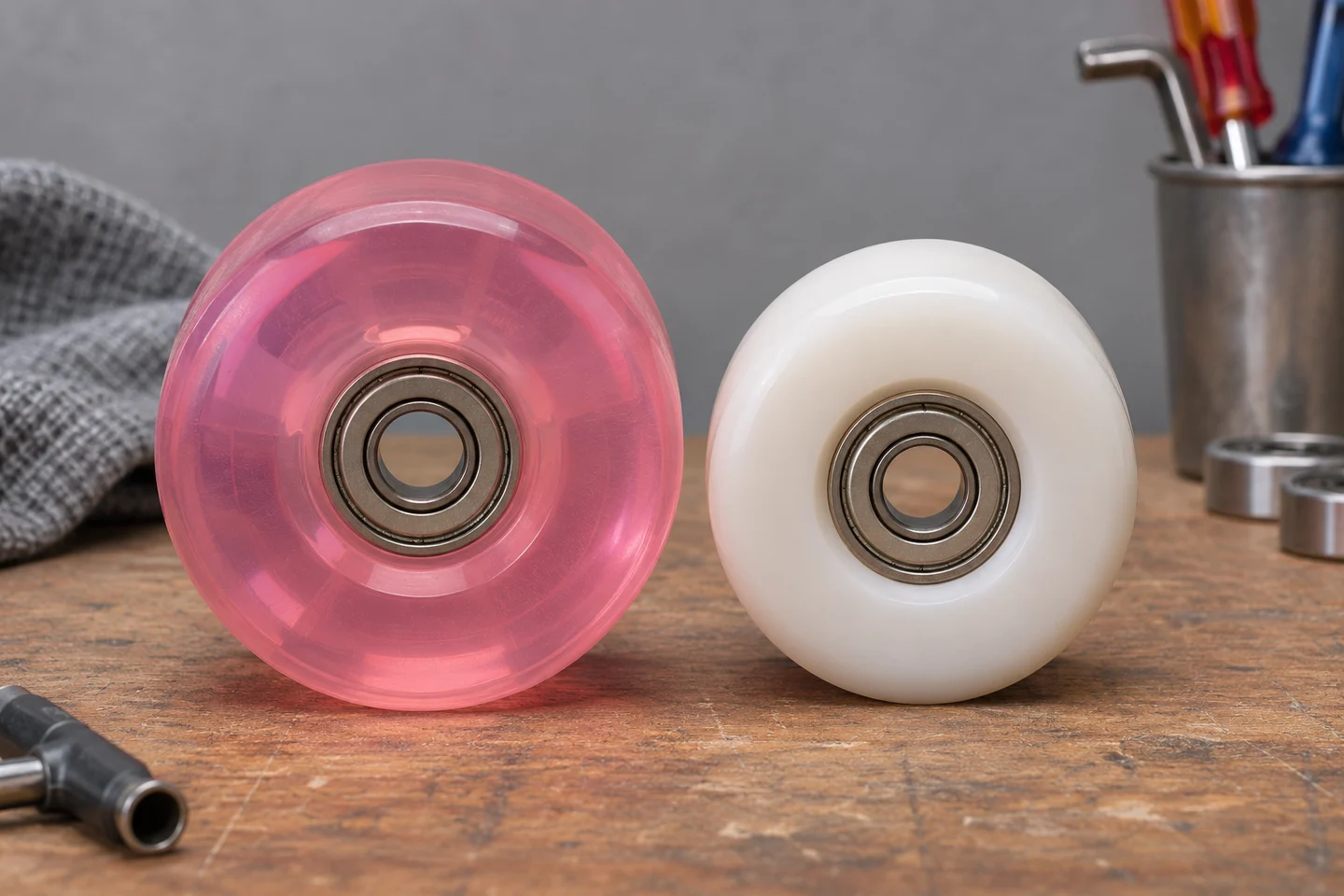
If you split time between an outdoor path and a rink, a hybrid wheel may be a practical first choice. A second set makes more sense once you know exactly what you want the existing one to do differently.
Profile and size
Look at the part of the wheel that touches the floor. A broader contact patch can give you more material on the surface and a planted feel. A rounded edge can feel easier to roll onto or turn through. Larger wheels can carry momentum and smooth out little cracks. Smaller wheels keep you closer to the floor and may feel more responsive.
Before buying, check clearance and fit. A skateboard wheel needs space under the deck when the trucks turn, and quad wheels need clearance around the plate and boot. Bring the old wheel or its measurements when you ask for help choosing a replacement.
Read a quad wheel label
A wheel listed as 62 × 35 mm, 78A is 62 mm in diameter and about 35 mm wide, with a softer Shore A compound. A 57 mm, 98A wheel is smaller and harder, a combination you might compare for smooth rink or dance use. The taller wheel raises you by about 2.5 mm in that example and usually carries over rough patches more readily. Hardness alone won’t tell you the grip: floor finish, wheel formula, profile and your weight also matter.
| Where you roll | Options to compare | Check first |
|---|---|---|
| Rough outdoor paving | Around 78–85A and 62–65 mm where the skate clears them | Boot and plate clearance under a lean, and control while stopping. |
| A smooth rink or sports hall | Around 85–95A as a first comparison | Ask about the rink finish and any wheel requirements. Start with the grip you can control. |
| Dance or a polished rink | Smaller wheels around 55–60 mm; harder compounds may suit experienced skaters | Try the floor before buying a very hard wheel. |
| Derby or hockey | Pick grip and profile with the club’s floor and play in mind | Check compound, hub, axle and the club’s equipment guidance. |
For a full pair of quads, count eight wheels and normally sixteen bearings. Compare bearing bore, hub fit and axle thread engagement before skating.