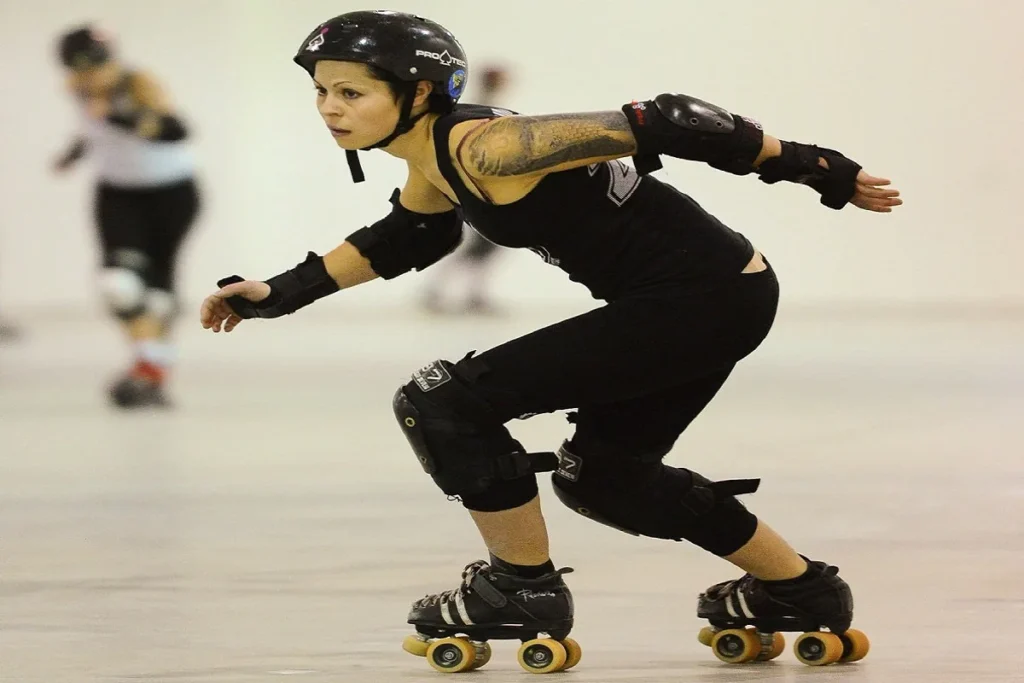
The whistle goes and two skaters with stars on their helmets drive into a moving wall. One tries to slip around the edge. The other looks for space between two blockers. Within seconds the same blockers who were holding an opponent back are trying to open a lane for their own teammate. That switch between attack and defence is what makes roller derby so absorbing to watch.
Roller derby is a full-contact team sport played on quad skates. This guide follows the modern flat-track game, from what happens in a jam to how the sport grew from marathon skating into a league-run competition.
Who does what?
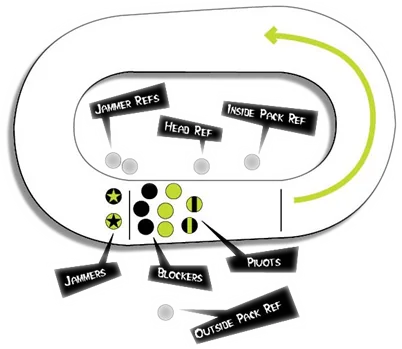
Each team can field up to five skaters in a jam. The jammer wears a star on their helmet cover and scores points. The other skaters are blockers. They try to slow the opposing jammer and help their own through. One blocker can be a pivot, identified by a stripe. If their jammer legally passes them the star, the pivot becomes the jammer for the rest of that jam.
How a jam works
A bout is played in two 30-minute periods, broken into passages of play called jams. Each jam lasts up to two minutes. On the first trip through the pack, the jammers establish position and try to earn lead status. After that initial trip they can score as they lap the opposition, earning a point for each opposing blocker they legally pass on a scoring trip. The designated lead jammer can end the jam early with a signal at their hips.
Watch how that plays out. Suppose the lead jammer gets through for four points while the other is still coming around the track. Calling off the jam can protect those four points before the other team gets a chance to score. If their blockers are still holding the other jammer, they might go round again instead. The scoreboard tells you what they gained. The distance between the two stars tells you what they had to decide.
What to watch in your first bout
Follow one star for a whole jam. Then spend the next jam watching a single blocker. Look for how they brace a teammate, move sideways to close a gap, or peel away to clear a route for their own jammer. The pack has a specific meaning in the rules. It is the largest group of nearby upright, in-bounds blockers that includes skaters from both teams. Where the pack is affects where blockers can engage.
Referees penalise actions such as tripping, using elbows to block and illegal contact to the back. If a jammer goes to the penalty box, the other team can have the only scorer on the track for a spell. Listen for a change in the crowd when this happens. The team with the chance to score still has to get its jammer through the wall.
The history of roller derby
In 1935, promoter Leo Seltzer opened his Transcontinental Roller Derby at the Chicago Coliseum. Its premise was an endurance race. Pairs of skaters made lap after lap around a banked track to cover the equivalent of a journey across the United States. The struggle for position caught spectators’ attention. Seltzer and sportswriter Damon Runyon are associated with the changes that turned that contact into part of the competition.
Professional derby developed into arena entertainment and reached much wider audiences through television. The grassroots revival in the early 2000s took the sport in another direction. A flat track could be laid out in a suitable sports hall, opening the game to leagues that had no purpose-built rink. Skaters built and ran teams, and standardised rules gave clubs a way to compete against one another. Women’s leagues drove much of that revival. Men’s and mixed derby also developed.
Modern derby still has some of the colour of those arena years, from team identities to the energy of the crowd. On a flat track, the work behind that spectacle is there to see. A handful of skaters make and remake a wall, one jammer spots a space, and both teams have to make a decision before it closes.
How to get involved
Start by watching a local bout or asking a league about its next beginner intake. Ask what you’ll practise first, whether the club has loan kit and what protective equipment you’ll need. Beginners often spend time on stops, changes of direction and moving safely with other skaters before practising contact. Leagues also need officials who skate and people who time jams, track penalties and keep score off skates.