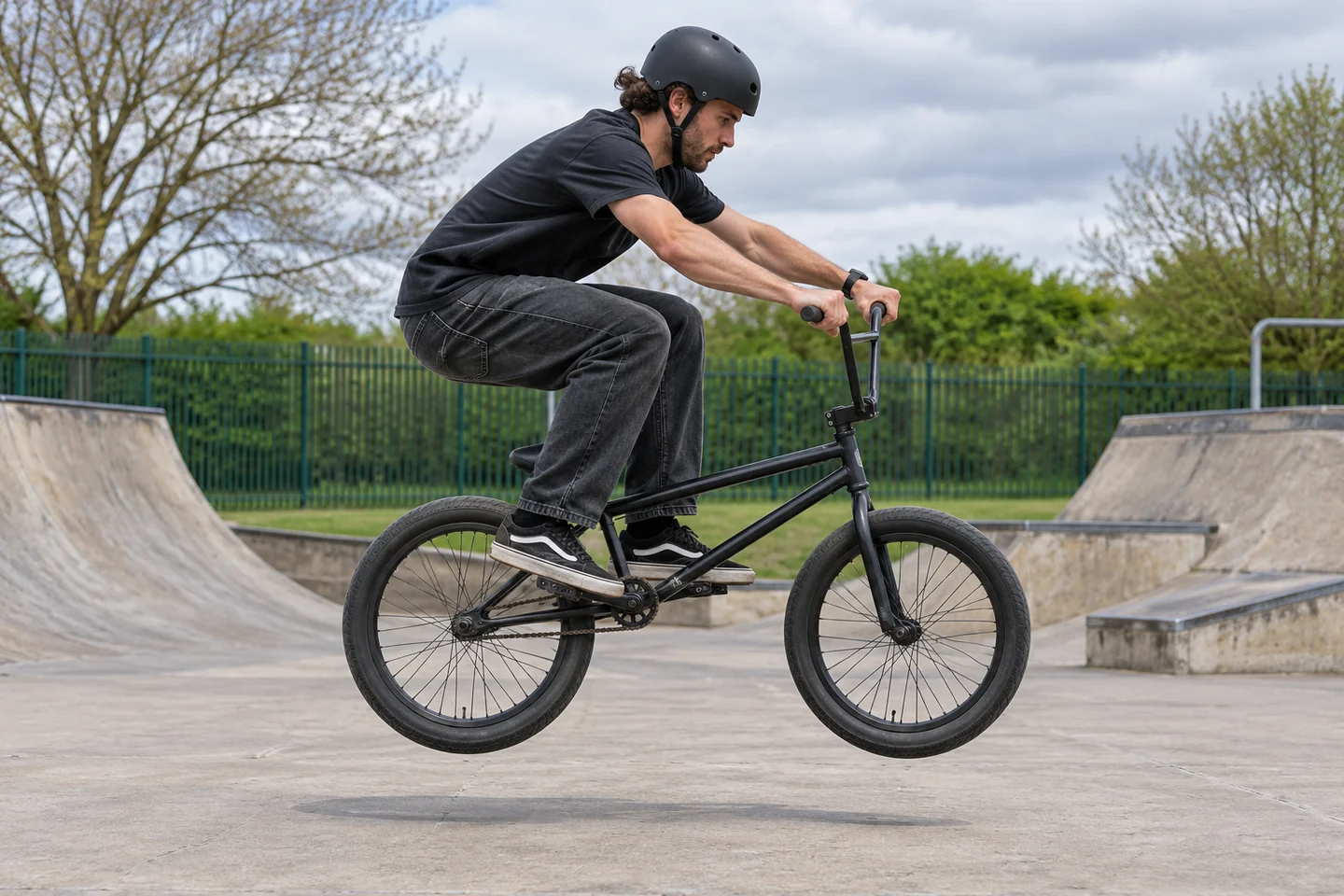
If you’ve ever replayed a BMX clip to work out how the rider landed it, start by watching one thing. Did the bike and rider turn together? Did the bars or frame move separately? Or was the trick about balancing on a wheel or peg? This list gives you the names and something to look for in each one.
Balance and first moves
- Bunny hop. The rider lifts the front wheel, then brings the rear up so both wheels clear the ground. It’s the starting point for getting onto many street features.
- Manual. The rider rolls on the back wheel with the front up and the pedals still. A wheelie uses pedal strokes to help keep the front wheel up.
- Fakie. The rider rolls backwards, often after coming down a bank or landing a 180. Watch the pedals. Some hubs make the cranks turn as the bike rolls back.
- Rollback. The turn that takes the rider out of a fakie and back into forward travel. Watch where their head turns and when the front wheel comes round.
- Nose manual. The rider balances over the front wheel while the rear stays off the ground. The point of balance moves from the back of the bike to the front.
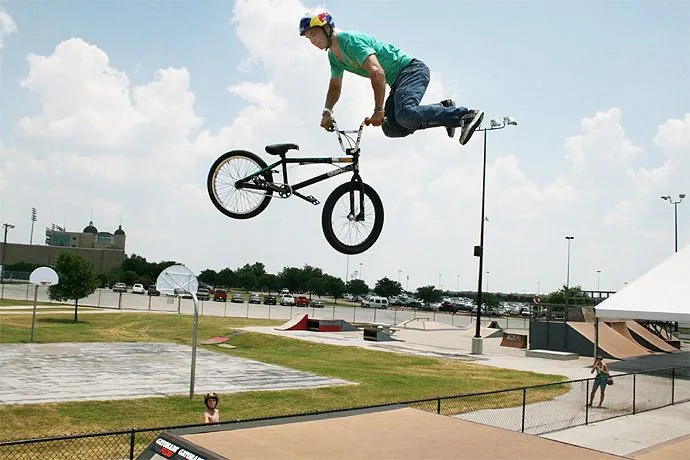
Spins, bars and frame
- 180. The bike and rider turn half a circle. On flat ground, that usually means landing into a fakie.
- 360. The rider and bike complete a full turn. The approach and exit can face the same way, so look for the rotation in the air.
- Barspin. The handlebars make a full turn and are caught again. The frame stays in its original orientation unless the move is combined with another trick.
- X-up. The rider turns the bars far enough for their arms to cross while both hands keep their grip, then straightens the bars for the landing.
- Tailwhip. The frame and rear wheel sweep a full turn around the front end while the rider holds the bars. Watch for the moment their feet find the pedals again.
- Turndown. The rider turns the bars and twists the bike into a steep, folded shape with the legs extended before opening back up. Look at the angle of the frame as well as the bars.
Air tricks and shapes
- Tabletop. The rider leans the bike sideways so the wheels come close to horizontal. A still photo often shows the shape better than a fast clip.
- Toboggan. One hand grabs the saddle while the other turns the bars, often close to a quarter turn. The bike’s nose often drops.
- Can-can. One foot leaves its pedal and crosses the top tube. In a no-footed can-can, both feet leave the pedals and extend to the same side.
- Tuck no-hander. The rider brings the bars into the lap or body, then takes both hands off before bringing them back for the landing.
- Nothing. Both hands and both feet leave the bike at the same time. Watch for that moment of separation.
- Backflip. Bike and rider rotate backwards together through a full revolution. A flair adds a half-turn to a backflip, usually to return into a transition.
Grinds and stalls
A handrail is an obstacle. To name the grind, look at which pegs or wheels touch it. On a ledge you can often see the wheel position more clearly.
- Double peg grind. Both pegs on the same side of the bike slide on the edge or rail.
- Feeble grind. The rear peg slides on the edge while the front tyre rides along the top of the ledge.
- Smith grind. The front peg slides on the edge while the rear tyre rides along the top.
- Icepick grind. The rear peg slides with the front end lifted. If the rider holds the position in place, it’s an icepick stall.
- Toothpick grind. The front peg does the sliding and the rear end stays raised.
Pick a line to watch twice
Try a 180 clip at half speed. Call out the take-off, the fakie and the rollback. You’ve just spotted three skills in a move that lasts a couple of seconds. If you’re learning to ride, start with the hop and backwards roll on a clear, suitable surface. Treat rails and advanced airs as moves to recognise and work towards with coaching.
Check your BMX before a park session
What sponsors look for beyond a trick list
Tell the trick from the approach and landing
A 180 to fakie links a half-turn to backwards travel. The rollback is the exit. A 180 barspin adds a full rotation of the bars during the half-turn, while a tailwhip sends the rear wheel around the steering axis. Slow a clip down and follow the front wheel, then the rider’s hands. On a ledge, watch which peg slides and which tyre rolls on top to distinguish a feeble from a smith.