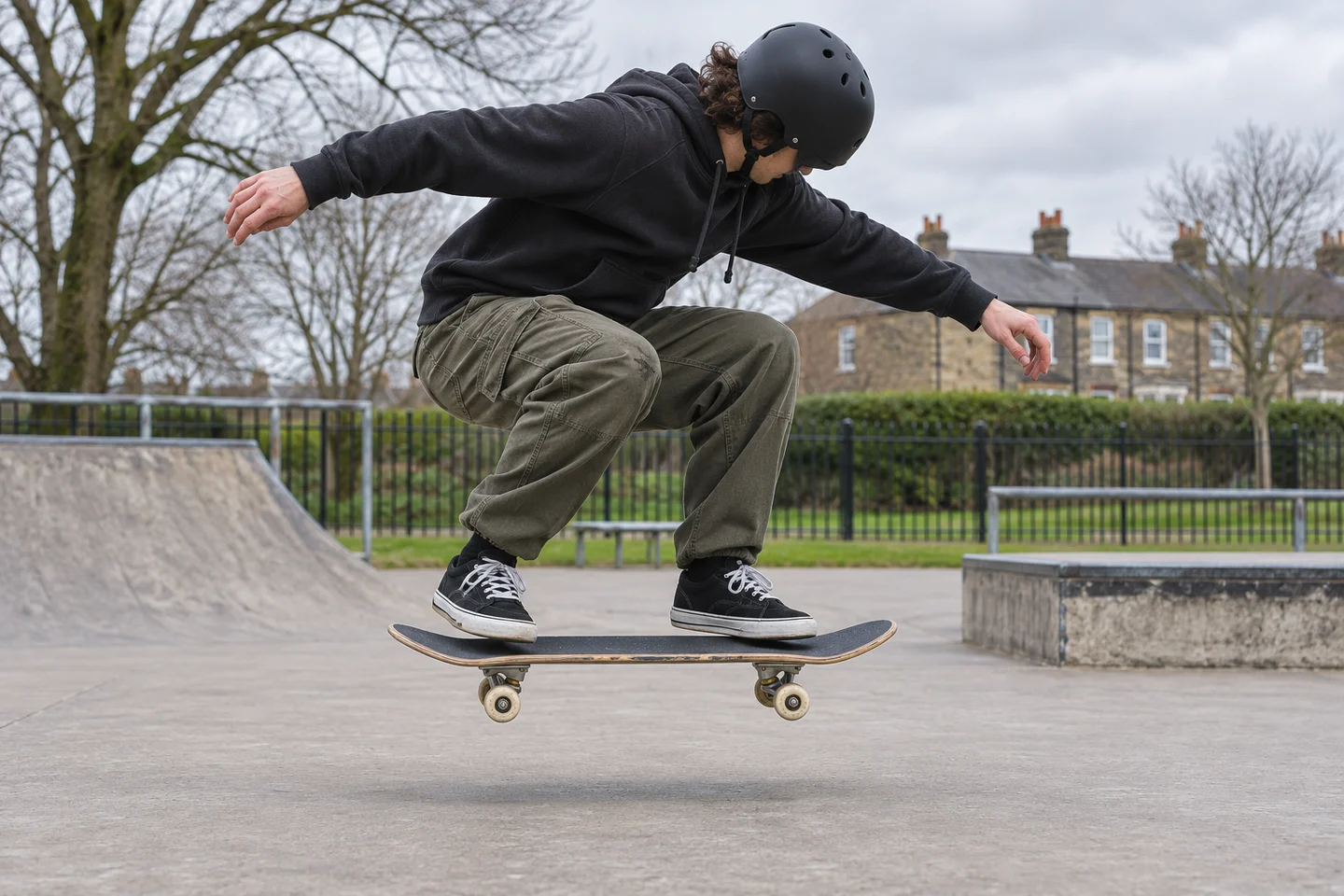
An ollie lifts the board, a shuvit turns it and a kickflip rolls it over. Those differences are easy to miss at full speed. Use this list to spot what the board, trucks and skater each do.
Flat-ground tricks
- Ollie. The skater pops the tail and brings the board off the ground with them. Watch the board level out before it lands.
- Shuvit. The deck rotates half a turn flat beneath the skater. A pop shuvit lifts the board with a pop as it turns.
- Frontside or backside 180. The skater and board turn half a circle together. Frontside and backside distinguish which way they turn from their stance.
- 360. The skater and board turn a full circle together. A 360 shuvit names a full rotation of the board beneath the rider.
- Kickflip. The deck rolls once along its length after a flick off the heel-side edge with the front foot.
- Heelflip. The front heel sends the board rolling the other way along the same axis.
- Tre flip. The board combines a 360 shuvit with a kickflip. Watch the board turn and flip at the same time.
- Manual. The skater balances on the rear wheels without the tail scraping. A nose manual balances over the front wheels.
Slides and grinds
- Boardslide. The middle of the deck slides across a rail or ledge. The trucks straddle the feature.
- Noseslide. The nose of the deck slides on the ledge. A tailslide makes contact with the tail instead.
- 50–50 grind. Both trucks grind along the same edge. If you can see both hangers lined up on the coping, that’s your clue.
- 5–0 grind. The rear truck grinds while the front is lifted clear.
- Feeble grind. The rear truck grinds and the front truck hangs beyond the edge, with the board angled over it.
Ramps and balance
- Drop-in. The skater starts on the coping or at the top of the ramp and rolls down the transition. It’s a way to enter a line.
- Kickturn. The front wheels lift briefly as the skater turns on the rear wheels. On a ramp it can turn an uphill run back down.
- Rock to fakie. The deck rocks over the coping, then the skater returns into the ramp backwards.
- Hang ten. Both feet come to the nose and all ten toes hang over the end. This is usually associated with longboard or surf-style cruising.
Choose a move you can build on
If you’re new, get comfortable pushing, turning and stopping, then try a small kickturn or work towards an ollie on flat ground. If you’re watching a rail clip, pause where the skater meets the rail. Seeing whether it’s deck, one truck or two makes the trick much easier to name.
Choose a first skateboard that fits your stance
Identify the direction and the board contact
For a frontside 180 from normal stance, the chest opens towards the direction of travel through the first quarter turn. A backside 180 turns the back towards it. On a grind, first identify the point of contact: two trucks for a 50–50, rear truck with the front raised for a 5–0, or deck across the rail for a boardslide. Slow down the entry and exit if the camera hides the contact.