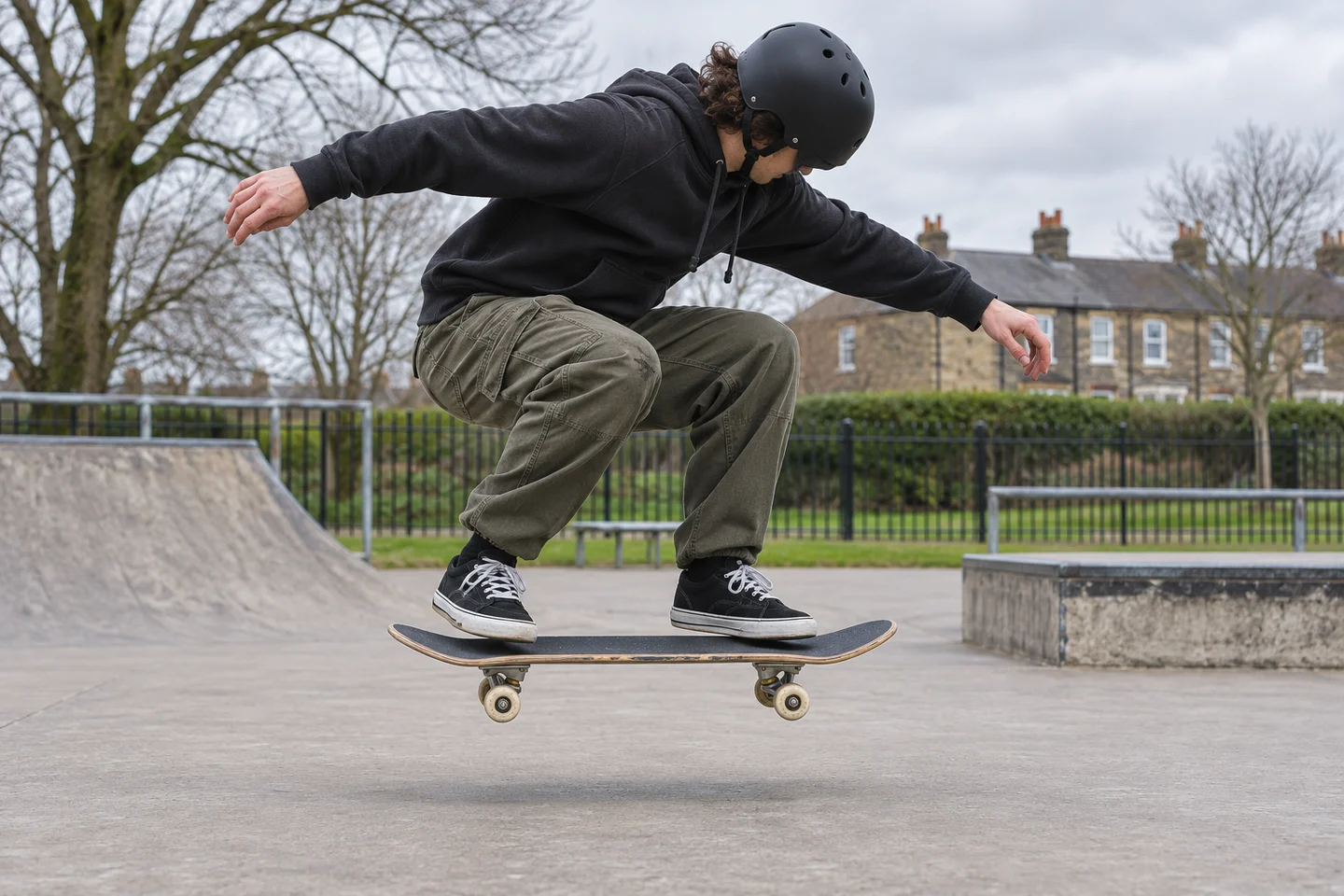
A first board should let you push, turn and get your feet back under you. For most new riders, a complete from a skate shop gets those basics right because the deck, trucks and wheels already work together. If someone is buying for a child, it helps to have them stand on the board before committing to a size.
Start with the rider’s stance
Measure deck width across its widest point. Deck length measures the whole board. The listed wheelbase usually measures between the inner truck mounting holes. It affects how far apart the rider’s feet sit in a comfortable stance. Two boards with the same width can feel very different when one has a shorter wheelbase.
Use the width bands below to make a shortlist. They’re starting points and overlap. Shoe size, leg length, the way the rider stands and where they’ll skate can all change the answer.
| If you’re buying for… | Deck width to try | Check on the board |
|---|---|---|
| A smaller child on a junior complete | Around 7–7.5 inches | A shorter wheelbase lets them reach the tail without stretching. |
| A growing rider between junior and full-size | Around 7.5–8 inches | Try both lengths. The rider should be able to bend and shift their weight without losing the stance. |
| A teen or adult learning general street and park | Around 7.75–8.25 inches | Compare which width gives enough landing room while remaining easy to turn. |
| A rider who likes more platform for transitions | Around 8.25 inches and wider | Check the board still feels manageable and that the trucks are matched to its width. |
If you’re buying online for somebody else, measure a board they’ve used comfortably or ask them to stand over the bolts in a shop. For a child on the boundary between two sizes, the board they can steer and reach the tail on now is the useful one. Age charts can help narrow the search before that check.
Read the parts list on a complete
A complete comes with a deck, grip tape, trucks, wheels, bearings and mounting hardware already fitted. For a first setup you can judge the components by what they let the rider do. A roughly matched truck axle and deck width help keep the wheels where you expect them under your feet. Stand on the board and lean each way slowly. Check the bushings allow some movement and the wheels don’t rub the deck.
A wheel around 52–54 mm is common on an everyday street or park complete. For rough pavement, a softer wheel usually takes the sting out of cracks. Compare clearance before going larger because a wheel that hits the deck can stop abruptly. If the rider mostly wants to travel along paths, look at a cruiser complete as well.
Bearings should turn freely and feel smooth under load. An ABEC number describes manufacturing tolerances. It doesn’t tell you how long a bearing will last in wet streets or how a complete will feel. Check that replacement wheels, bearings and hardware can be bought separately.
| Setup | Best first use | What you gain and give up |
|---|---|---|
| Junior double-kick complete | Smaller rider learning on flat ground | Shorter reach. Check they have enough room to land with both feet. |
| Standard double-kick complete | Street basics, flat ground and parks | Versatile shape and widely available parts. Wheel choice matters on rough ground. |
| Cruiser complete | Paths and short journeys | Smoother roll on many rough surfaces. Try a double-kick if learning flip tricks is the main plan. |
| Custom build | A rider who can name the part or feel they want to change | More choice. You have to check truck width, wheel clearance and hardware fit before ordering. |
Make the final choice
Compare the dimensions on the exact model before looking at the brand. Two sizes in the same range can use different deck shapes or wheels. If the prices are close, choose the better fit and the setup that suits your surface. Put the rest of the budget towards protective gear or a first lesson. A beginner can keep most of a good complete when they later decide to change one part.
Read the custom assembly guide
Complete skateboards to compare
 Blind Classic Saber Complete Skateboard Multi – 7.25″
 Blind Skate Park Global Warming Complete Skateboard Blue – 8″
 Blind Classic Hangman Soft Top Complete Skateboard Red – 7″
Skateboard GB
Skateboards and equipment for beginnersSee the board and protective equipment before choosing a first setup.
Make a first-session plan
Find a clear, smooth flat spot and learn to step on, push and stop before heading into a busy park. A lesson is a useful option if you want a coach to check the setup and help you get moving.
Read a complete’s measurements together
An 8.0-inch popsicle is a useful comparison for general street and park. An 8.25-inch deck gives a little more room without automatically making the stance much longer. Check the listed wheelbase and the tail reach rather than using shoe size alone. A short rider may be happier on the wider deck if its bolt spacing and tail are easier to reach.
If a complete lists 52 mm / 99A wheels, 52 mm is the diameter and 99A is the hardness. That is a useful smooth-ground starting point. For rough paths, compare a softer wheel first. If choosing a larger diameter at the same time, ask the shop to check wheel bite.
See the parts, deck shapes and measurements
Compare diameter, hardness and wheel shape
Frequently asked questions
Should I buy a bigger board for my child to grow into?
Buy the board they can reach and steer now. A deck that feels too long may make it hard to shift the rear foot onto the tail.
Do I need a custom skateboard to learn tricks?
A properly sized double-kick complete is enough to start. A custom build makes sense when you can explain what you’d change about the deck, trucks or wheels.
Can I use one board at the park and on the pavement?
Yes. If most of the rough ground is on the way to the park, compare wheels with a little more give and check that the diameter clears the deck.