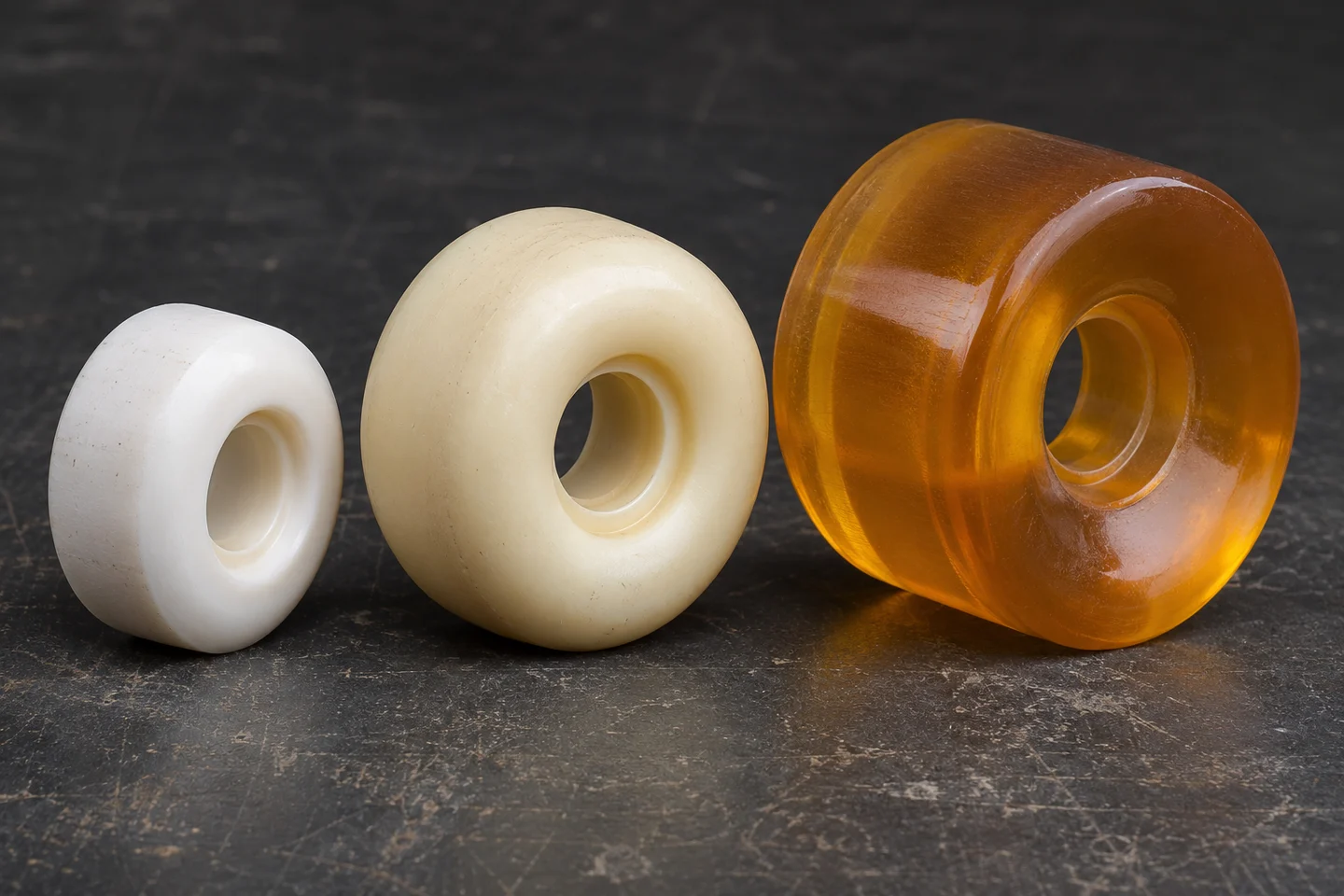
A smooth indoor park and a cracked pavement ask different things of a wheel. If the board is vibrating so much you can’t stay comfortable, you may need a different wheel long before you need new bearings. Pick your usual ground and then choose what you want the wheel to feel like.
Size and hardness
A small wheel keeps the deck lower and can feel quick to move for technical skating. A bigger one tends to carry momentum and roll over imperfections more easily. On the A hardness scale, a lower number usually means a softer wheel. Softer wheels can make rough ground more comfortable. A harder wheel may suit a smooth park if you want a firmer feel and easier release into slides.
The contact patch changes the feel
Two wheels with the same diameter and hardness can feel different because their shapes and urethane formulas differ. A wider contact patch often feels planted. A rounded edge can feel easier to shift between movements. If possible, compare a wheel you’ve already skated with the one you’re considering.
Check wheelbite
A bigger wheel needs room under the deck when you lean. Look at your trucks, the shape of the deck and whether the manufacturer recommends risers. Risers may need longer mounting bolts. Make a slow clearance check before using a changed setup normally.
Work from the surface towards a shortlist
Durometer helps compare wheels on the same scale. Urethane formula, contact patch and shape still change how a wheel grips. Don’t expect every wheel with the same number to behave the same. If you’re comparing two changes, swap wheels before touching truck tension so you can tell what made the difference.
Decode the numbers on a wheel
A listing such as 54 × 32 mm, 99A usually gives the outside diameter, overall width and hardness. Overall width includes the shoulders; the contact patch is the narrower strip that sits on the ground. Rounded lips can release a little more readily into a slide, while a wide contact patch or square lip can feel more planted. Check the maker’s contact-patch figure when it’s available.
Shore A and Shore B measure resistance to indentation on different scales. On the same scale, higher means harder. A typical 78A cruiser wheel deforms more than a 99A street wheel under a similar load. At the hard end some makers use B; Bones gives 84B as the equivalent label to 104A for its Skate Park Formula. A-scale instrument readings end at 100, so figures above 100A are maker comparisons. Two wheels with the same printed number can still feel different because the urethane, rebound and shape differ.
| Your riding surface | Compare first | Why |
|---|---|---|
| Rough paths and rolling between spots | Around 56–60 mm and 78–87A if the setup clears them | More give over coarse paving and more diameter to roll over small cracks. |
| Mixed street and park | Around 53–56 mm and an intermediate compound, such as 87–97A | A compromise between comfort and the release you want for tricks. |
| Smooth concrete and ledges | Around 50–54 mm, often 97–101A as labelled by the maker | Lower ride height and less deformation on a smooth surface. |
| Smooth bowl or transition | Around 54–58 mm in a hard park compound | Carries speed and keeps its shape. Compare grip on that specific surface. |
Check clearance before ordering
Going from 52 to 58 mm takes up about 3 mm of space above the axle, before any change in width or lip. Check both trucks under your weight. Look for rub marks on the underside and compare the new wheel’s clearance at full lean. Keep axle washers and spacers in the maker’s arrangement and confirm the nut engages. Try the new setup at low speed and repeat the lean check.
See how wheel size, truck height and risers work together
Frequently asked questions
Why does the board stop suddenly when I lean?
Check for wheel marks under the deck. A wheel may be contacting it during a turn. Check clearance and consult a shop before skating the changed setup at speed.
Can I keep the same bearings?
If they’re in good condition and fit the new wheel and axle, yes. Check the spacers and washers the setup needs.